 History > Local History >Wartime & Windsor’s Auto Industry
Wartime & Windsor’s Auto IndustryAlthough the Ford Motor Company was established in Windsor as early as 1904, it was during and following the First World War that real growth was seen locally. The automotive industry changed Windsor from a relatively slow growing collection of border communities to a rapidly growing, modern industrial city. An area known as "Ford City" was even developed around the factory itself. By the Second World War, industrial production increased dramatically, attracting many new workers and resulting in even more substantial residential growth within the city and in the surrounding townships. |
 |
As a
newly amalgamated city, (Windsor, East Windsor/Ford City, Walkerville,
and Sandwich) Windsor had become one of the world's leading
automobile manufacturers, ranking fourth in the world in the
output of cars and trucks. |
|
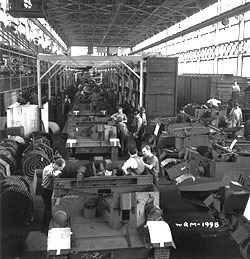
By 1940, Canadian auto plants were contributing to the war effort by turning out over 600 armoured personnel carriers a day. Ford was one of the first to convert to military production building approximately 336,187 trucks and 33,992 carriers, for use by Allied forces. This was the largest single source of military land transport in the British Empire and far exceeded the output of Germany, Italy, and Japan combined. Ironically enough, Henry Ford’s attitude towards war, in the past, had been anything but supportive. During the First World War, he'd remarked to the Detroit Free Press that he would give all of his money to stop it [WWI] and that the building of armaments by the U.S. was "wasteful and war breeding." In the years to come, the local auto industry was put to good use, building all types of war materials - not only vehicles, but artillery as well. Border Cities Industries, manufactured the Browning Automatic Machine Gun in Windsor's General Motors-managed plant. It was at Border Cities, also, that the women of Windsor became an integral part of local manufacturing history as they were solely responsible for assembling the guns. When many of Windsor's factory workers (who were exclusively male) went to war, women found many more opportunities for employment. Due to the labour shortage, companies such as Chrysler and General Motors employed women, on the line, to replace the absent male factory workers. Though, with the conclusion of the war, things returned to old form. As workers returned from military service, they pushed to reclaiming their place on the line, and women's participation in the auto industry, largely, came to an end. After the war, the plants swiftly switched back to their business-as-usual production. Due in part to the wartime prosperity of companies like Ford, a boom in automobile sales resulted in the company, and others, expanding beyond their Windsor base. For more information on the history of Windsor's Auto Industry
please visit SOME ASSEMBLY
REQUIRED, another Windsor Public
Library Digital Exhibit. |
|