 History > World War I
 |
| Click here to view WWI timeline |
|
WWI
No one had expected the assassination of Austro-Hungarian Archduke Franz Ferdinand would lead to the devastation of the First World War, but that situation dramatically changed the political landscape of the world at that time. Four years of devastation were to follow, and World War I (or the Great War as it’s also been called) would definitely divide the world in a way that it never had been before. Two major alliances would form - Germany, Austria-Hungary, and Italy pitted against France, Russia and Great Britain. Not only did this undermine Europe, but the entire world was affected. And that’s when Canada’s involvement began. In 1914, Britain's ultimatum for Germany to abandon an invasion of Belgium went unanswered and soon Britain was heading toward battle. Canada, as a member of the British Empire was automatically at war and although the nation only had a small army of soldiers at just over 3,000, the supportive response from the Canadian public was overwhelmingly favourable. By 1917, three years into the conflict, enlistment had risen to 50,000. |
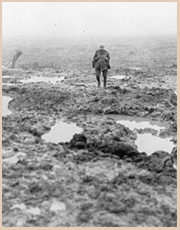 |
Canada saw conflict like never previously imagined. And Canadian soldiers paid for it in tragic numbers. Some particularly devastating battles were the poison gas attacks of Ypres in 1915, and the Somme and Vimy Ridge fights in 1916. Vimy was a bloody and tragic event, and the city of Windsor was profoundly affected as the list of casualties from the area was particularly high.
Ultimately, Canada's eventual success and victory at Vimy marked a turning-point for the allied nations and not long after, the Great War was over. On the 11th hour of the 11th day of the 11th month, an armistice ended WWI. Canada’s heroics earned it a separate signature on the Versailles Peace Treaty that ended the war, and also helped to establish Canada as an independent nation.
In four years of battle, over 170,000 were wounded and 59,544 died in battle.
The Great War involved virtually all of Canada and placed enormous
demands on Canadians, whether they were in battle or on the home-front.
Back home,
the success of the war helped incite Canadians' pride at the courage
of soldiers, and established an entirely new feeling of nationalism.